Welcome to this week’s edition of the Threat Source newsletter.
Lately I've found myself thinking a lot about the Australian TV series Mr. Inbetween (IMDb 8.7/10) — not because I'm a hitman for hire, but because I literally feel in-between. Specifically, in-between what I'd call the "pre-Mythos" and “post-Mythos” eras. We've crossed a capability threshold, and it's not just one model family driving that — Codex 5.3 and GPT-5.5 deliver comparable or better performance, and Tulongfeng or GLM-5.2 (an incredibly powerful open-weight model, MIT-licensed) show the frontier isn't limited to closed models anymore.
On the other side of that line, real-world impact hasn't caught up yet and we're living in an artificial buffer zone. For me, defining the “pre-” and “post-” status comes down to the gap between "vulnerability discovery" and "vulnerability publication."
Last week’s Patch Tuesday gave a signal of change, as Joe pointed out, so maybe the buffer zone has come to an end.
Let's dive into the 2026 Q2 stats.
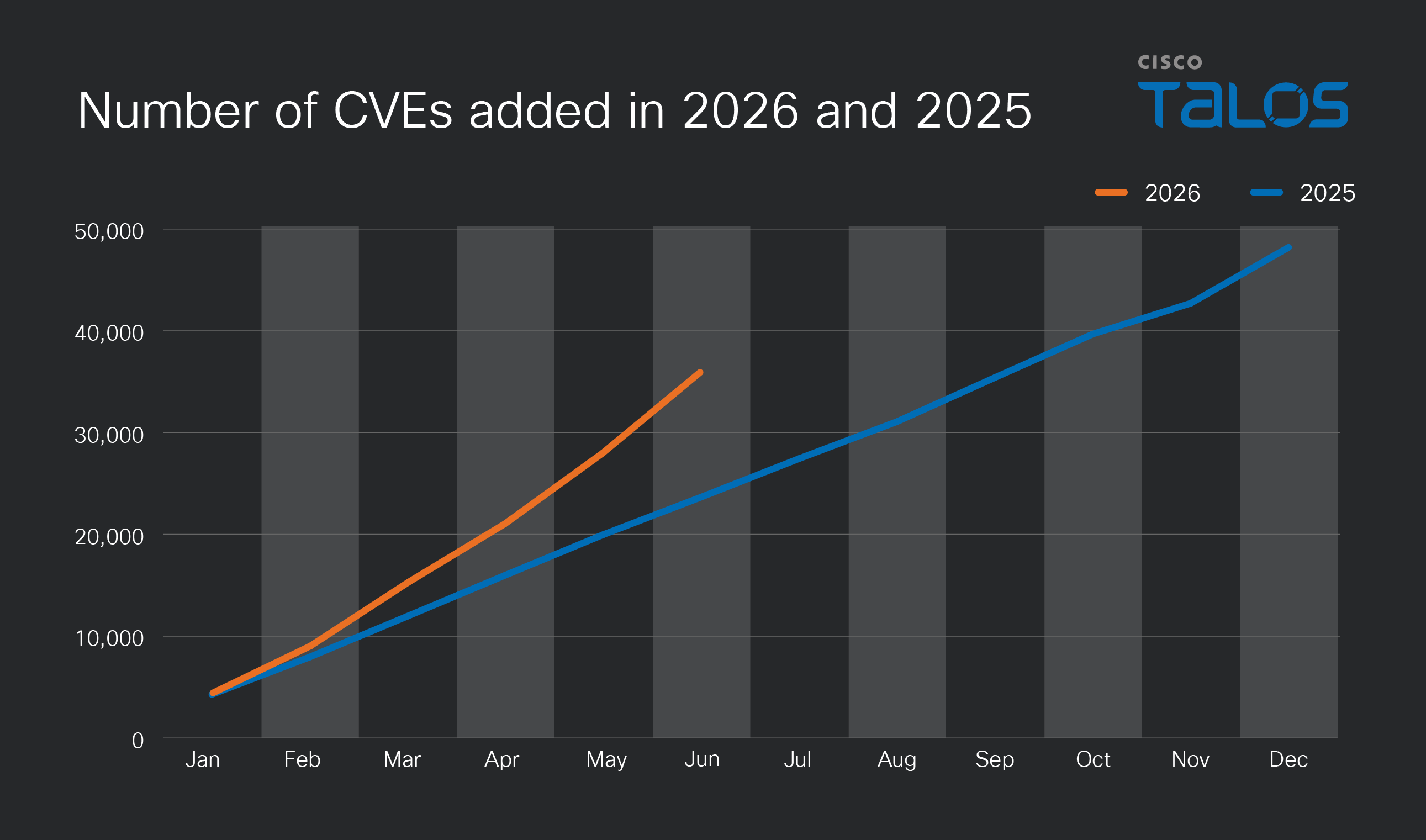
As in past years, we're seeing a steeper curve than the year before — a solid 49% YoY growth, though still not the hockey-stick moment I keep waiting for. By the end of June we were tracking close to 200 CVEs per day.
Using the keyword methodology described here, I found 452 AI-related CVEs this calendar year. If "openclaw" is added to the keyword list, that number jumps by another 536 — a reminder that these counts are sensitive to keyword drift. Given how much the keyword list keeps changing, I'm reconsidering whether to keep publishing this particular metric going forward.
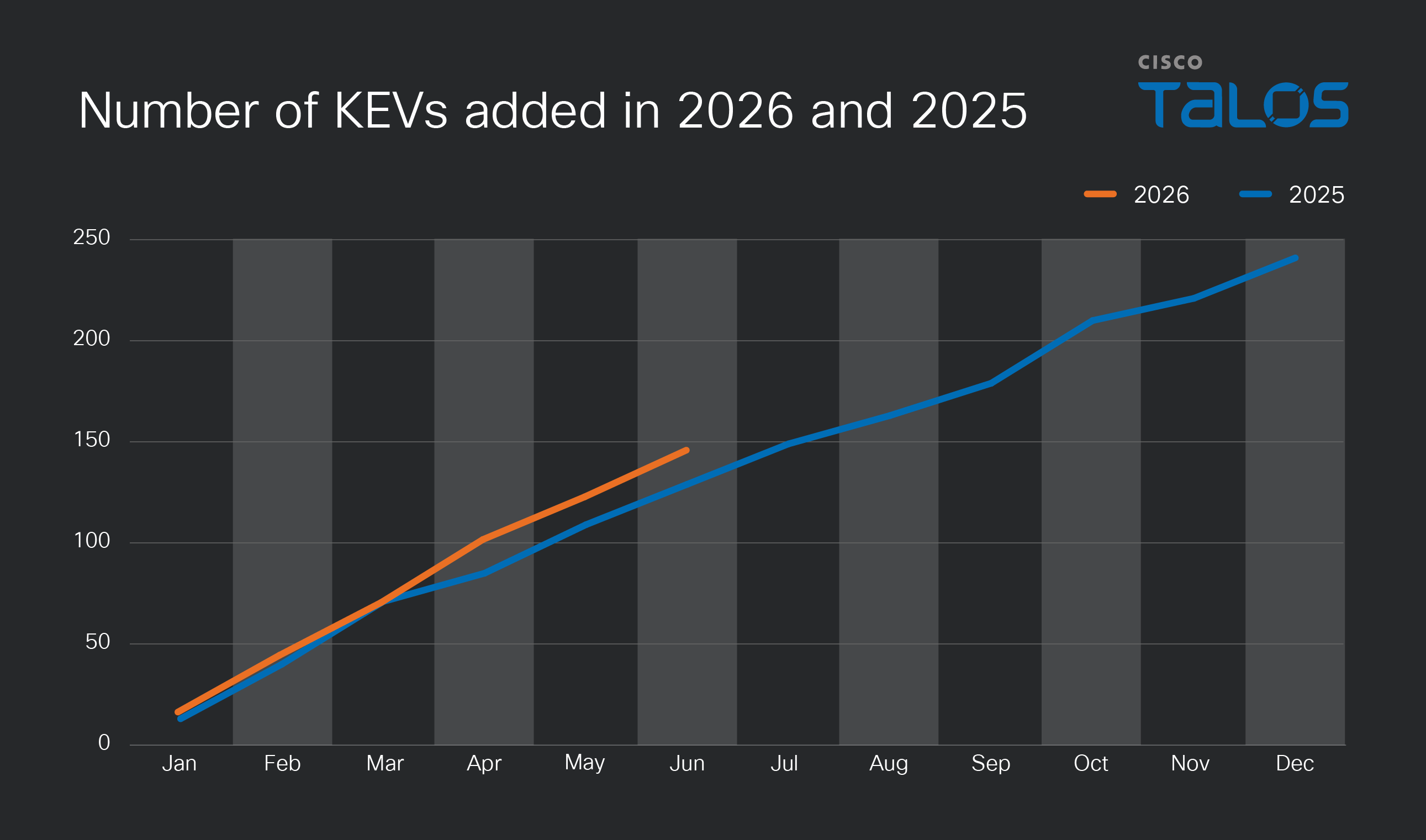
KEVs, by contrast, "only" grew 13% — a small April spike aside, it's fairly flat relative to total CVE growth. Networking-gear-related CVEs continued their climb, now accounting for 24% of KEV-related vulnerabilities (up from 20% in Q1) — consistent with the trend I flagged last quarters.
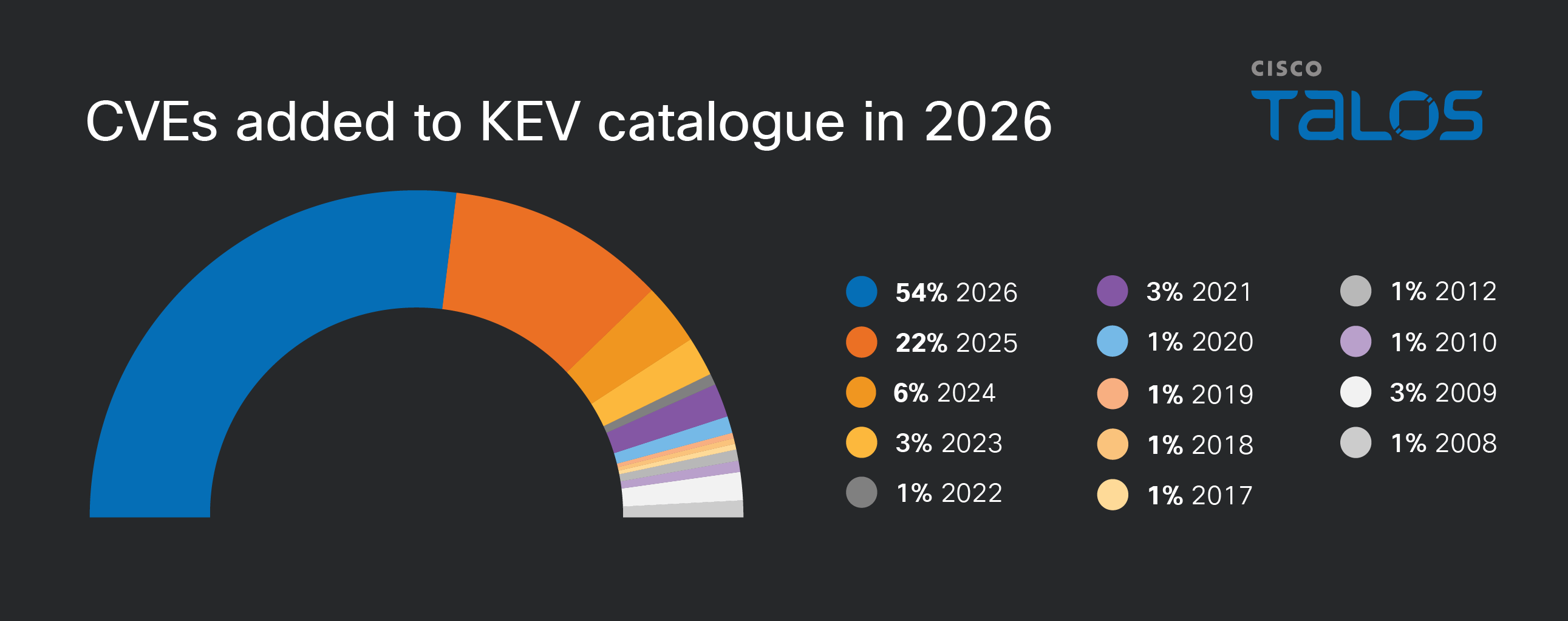
As in previous quarters, CVEs from 2024 or earlier still make up about 24% of everything we're tracking. More strikingly, even though the standard enterprise patch cycle is described to run 30–90 days, 181 days into 2026, 46% of today's actively-exploited (KEV) CVEs still trace back to 2025 or earlier.
Old vulnerabilities don't retire, new ones keep arriving, and machine-speed vulnerability discovery is going to keep outpacing human-speed patching. Which brings me back — once again — to EPSS as a tool for prioritizing patching against this dataset.
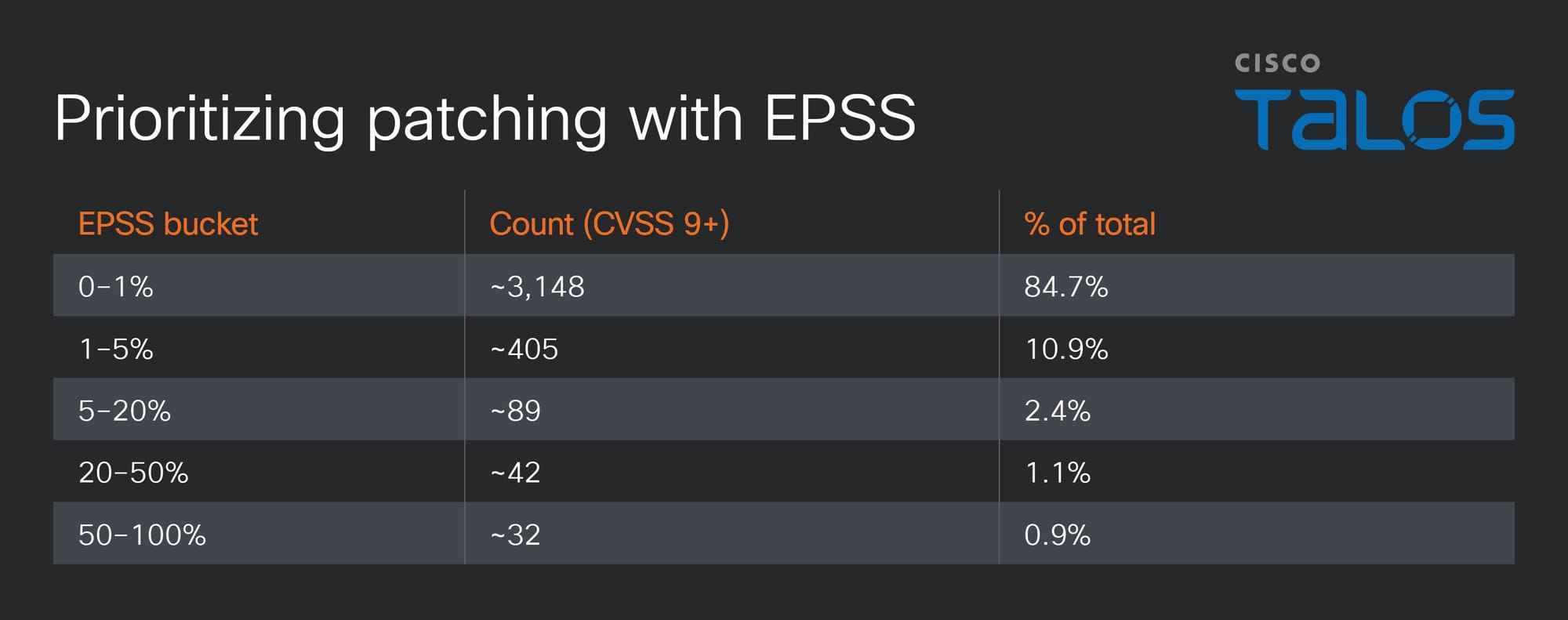
If you patched purely by CVSS 9+, you'd be urgently chasing ~3,700 CVEs — but 95% of those sit below 5% EPSS, meaning the real-world odds of exploitation are tiny.
Of the 32 CVSS 9+ CVEs with EPSS ≥ 50%, 25 are already on CISA's KEV list. The remaining seven outliers are still high-probability by EPSS but haven't made KEV yet — worth watching.
Ray Shoesmith (Mr. Inbetween) once told his therapist, "You know, if I hit somebody, I generally got a pretty good reason."
Same principle applies to patching. Don't swing at everything — swing at what you have good reason to believe is coming for you.
The one big thing
Cisco Talos has discovered "msaRAT," a new Rust-based remote access trojan (RAT) deployed by the Chaos ransomware group. Built on the Tokio asynchronous runtime, it establishes a covert command-and-control (C2) channel by hijacking Chrome or Edge browsers via the Chrome DevTools Protocol (CDP). The infection starts with a deceptive MSI file masquerading as a Windows update that loads the payload directly into memory, paving the way for ransomware deployment.
Why do I care?
This RAT is a master of evasion, living off the browser to build its C2 infrastructure without ever directly touching the network. By routing traffic through legitimate browser processes and trusted services, msaRAT easily bypasses traditional network-based detections. Additionally, its use of the Tokio runtime enables highly efficient, parallel execution of malicious tasks, accelerating the attacker's ability to establish persistence and deploy double-extortion ransomware.
So now what?
Defenders should monitor for unusual curl commands, especially those downloading MSI files to the ProgramData directory or sending plain HTTP traffic over port 443. Scrutinize unexpected MSI files impersonating Windows updates and watch for unauthorized Chrome or Edge manipulation. Finally, implement behavioral monitoring to catch Chrome DevTools Protocol abuse and unauthorized WebRTC connections. Read the full blog for complete coverage and indicators of compromise (IOCs).
Top security headlines of the week
Introducing Antares: Highly efficient open weight AI models for vulnerability localization
This week, Cisco introduced Antares, a family of security small language models (SLMs) purpose-built for pinpointing where known vulnerabilities exist within a codebase. (Cisco)
Hacker wipes European country’s entire land registry database, paralyzing real-estate market
A hacker wiped Romania’s entire land registry database after an unsuccessful extortion attempt. The attack halted all property transactions, preventing notaries from authenticating sales or registering mortgages nationwide. (Cybernews)
"WP2Shell” opens millions of WordPress sites to remote takeover
Barely three days after disclosure, attackers are widely chaining together CVE-2026-60137 and CVE-2026-63030 to lob exploit attempts against one of the largest attack surfaces on the Internet. (DarkReading)
Progress tells ShareFile customers to shut down Storage Zone Controllers over security threat
Only the Storage Zone Controller is affected, not standard cloud-only ShareFile accounts. The controller is a server that a company runs itself, so files can stay on its own storage while it still uses ShareFile's cloud to share and manage them. (The Hacker News)
Microsoft SharePoint under attack via new exploit
Researchers warned that patching is not enough to address the deserialization flaw and that security teams “should rotate credentials on any assets that may have been exposed.” (Cybersecurity Dive)
Can’t get enough Talos?
[Video] Where protection starts: Cisco Talos Intelligence Integrations
Every day, defenders make high-consequence decisions with incomplete information. Learn how Cisco Talos Intelligence Integrations help reduce uncertainty by turning the latest threat intelligence into proactive protections across Cisco technologies.
The Hunter's Paradox: Is it time to embrace automated threat hunting?
Humans can no longer keep up with the volume and velocity of security data on their own, but AI can't be fully trusted. David discusses the merits of both and what the future might look like.
The serpent’s tongue: Luring the Python out of its den
Protect your development environment from rising Python supply-chain threats by understanding the package installation lifecycle and implementing these essential defensive strategies.
Keeping up with the cybercriminals
In this episode of Beers with Talos, Hazel, Bill, Dave and Joe are joined by Kendall McKay to dive into the soap opera of modern cybercrime. Turns out, every ransomware operation is one passive-aggressive group chat message away from falling apart.
Upcoming events where you can find Talos
- Black Hat USA (Aug. 1 – 6) Las Vegas, NV
- DEF CON 34 (Aug. 6 – 9) Las Vegas, NV
Most prevalent malware files from Talos telemetry over the past week
SHA256: 9f1f11a708d393e0a4109ae189bc64f1f3e312653dcf317a2bd406f18ffcc507
MD5: 2915b3f8b703eb744fc54c81f4a9c67f
Talos Rep: https://talosintelligence.com/talos_file_reputation?s=9f1f11a708d393e0a4109ae189bc64f1f3e312653dcf317a2bd406f18ffcc507
Example Filename: VID001.exe
Detection Name: Win.Worm.Coinminer::1201**
SHA256: 9896a6fcb9bb5ac1ec5297b4a65be3f647589adf7c37b45f3f7466decd6a4a7f
MD5: 38de5b216c33833af710e88f7f64fc98
Talos Rep: https://talosintelligence.com/talos_file_reputation?s=9896a6fcb9bb5ac1ec5297b4a65be3f647589adf7c37b45f3f7466decd6a4a7f
Example Filename: SECOH-QAD.exe
Detection Name: Win.Tool.Procpatcher::1201
SHA256: e60ab99da105ee27ee09ea64ed8eb46d8edc92ee37f039dbc3e2bb9f587a33ba
MD5: dbd8dbecaa80795c135137d69921fdba
Talos Rep: https://talosintelligence.com/talos_file_reputation?s=e60ab99da105ee27ee09ea64ed8eb46d8edc92ee37f039dbc3e2bb9f587a33ba
Example Filename: u165714.dat
Detection Name: W32.Variant:MalwareXgenMisc.29d4.1201
SHA256: 633bd79d1efd3730234d907a2a0d98e3e253a5f0e222e4e4bf3badb3fd6aea0a
MD5: 770dbe473180366d7b539ff2c188e551
Talos Rep: https://talosintelligence.com/talos_file_reputation?s=633bd79d1efd3730234d907a2a0d98e3e253a5f0e222e4e4bf3badb3fd6aea0a
Example Filename: server_tcp.exe
Detection Name: W32.Trojan.27oc.1201
SHA256: 90b1456cdbe6bc2779ea0b4736ed9a998a71ae37390331b6ba87e389a49d3d59
MD5: c2efb2dcacba6d3ccc175b6ce1b7ed0a
Talos Rep: https://talosintelligence.com/talos_file_reputation?s=90b1456cdbe6bc2779ea0b4736ed9a998a71ae37390331b6ba87e389a49d3d59
Example Filename: tmp00055df5.dll
Detection Name: Auto.90B145.282358.in02