
CVE-2014-1761, Oh did you mean CVE-2012-2539?
When the VRT first received word of a new Microsoft Word 0-day I anxiously awaited details and the ever important hash of the in-the-wild exploit to be able to research it and provide coverage through Snort, ClamAV and the FireAmp suite of products. I was especially interested wh

Dynamically Unpacking Malware With Pin
A common approach that malware takes to hide itself is packing. Traditionally, packing was a means to compress your executable, then unpack and execute it at run time. Packing can also be used as an obfuscation technique for those who wish to hide their executable code. For a whi

Using the Immunity Debugger API to Automate Analysis

Osx.Trojan.Leverage, a Breakdown Using Dtrace
This article provides a brief introduction to canned DTrace scripts for the purposes of analyzing the malwaresample, Osx.Trojan.Leverage. For this sample, I only needed to use a few of the canned scripts to gather a significant amount of data about how this piece of malware impac
Micorosft Update Tuesday: March 2014, all about IE (including two 0-day fixes)
It's Microsoft Update Tuesday. While this month is relatively minor, a total of 5 bulletins, it is pretty large for the requisite Internet Explorer bulletin. There’s a total of 23 CVEs covered by the bulletins, 18 of which are found in IE. There’s 2 critical and 3 important
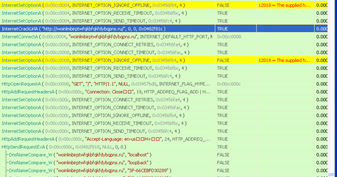
Decoding Domain Generation Algorithms (DGAs) Part III - ZeusBot DGA Reproduction
Note: The blog post is part 3 of 3. The first two blog posts can be found: Decoding Domain Generation Algorithms (DGAs): Part I Decoding Domain Generation Algorithms (DGAs) Part II - Catching ZeusBot Injection into Explorer.exe At this point, you can go ahead and close the two
Hello, a new specifically covered exploit kit
We're keeping a pretty close eye on Exploit Kits here at the VRT, and when a new trend or technique starts to rear its head, we pay close attention. Over the past week or so, we saw an exploit kit doing something unusual - this kit appears to be tracking the Windows systems
Decoding Domain Generation Algorithms (DGAs) Part II - Catching ZeusBot Injection into Explorer.exe
Last week, I talked about unpacking this binary for static analysis. This week, I am going to talk about catching its injected entry point inside explorer.exe. This makes it easier to dynamically analyze the code from the very beginning of its execution routine up to the code uti

Decoding Domain Generation Algorithms (DGAs) - Part I
Part 1 - Unpacking the binary to properly view it in IDA Pro Recently, I came across an executable(MD5: 3D5060066056369B3449606F3E87F777) that was expected to be malicious in nature, but its network behavior was what was really interesting. So the first thing I did was throw it