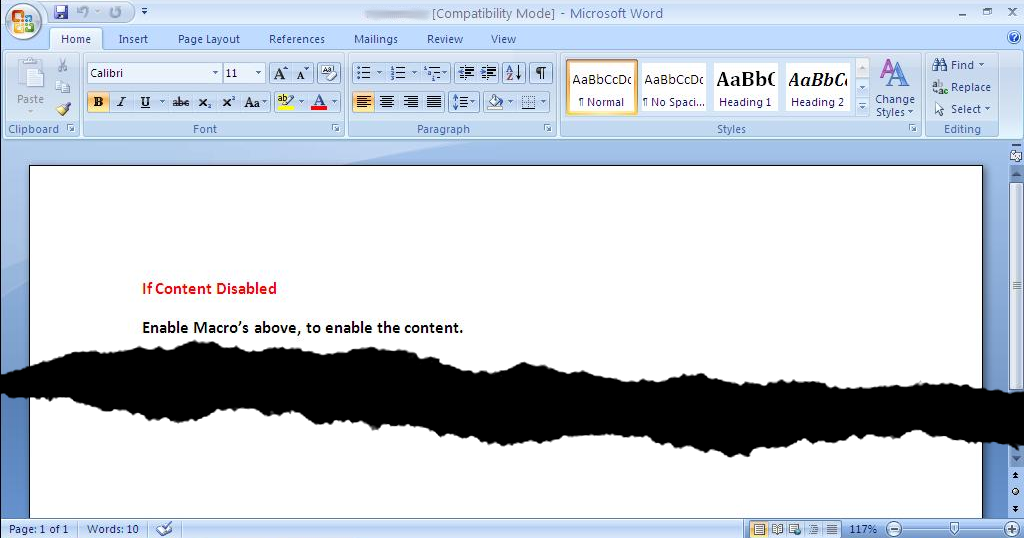
Threat Spotlight: "A String of Paerls", Part 2, Deep Dive
This post has been coauthored by Joel Esler, Craig Williams, Richard Harman, Jaeson Schultz, and Douglas Goddard In part one of our two part blog series on the “String of Paerls” threat, we showed an attack involving a spearphish message containing an attached malicious Word doc
Exceptional behavior: the Windows 8.1 X64 SEH Implementation
In my last post, you may remember how the latest Uroburos rootkit was able to disarm Patchguard on Windows 7 . I was recently looking into how Patchguard is implemented in Windows 8.1 and decided to dig into Exception Handling on x64. As a matter of fact, all the new 64-bit Windo
Detection for PutterPanda, we got this.
Recently a post by Crowdstrike was released detailing an attack being used, allegedly, by the Chinese Military "PLA Unit 61486". The post is a great demonstration of the use of OSINT (Open Source Intelligence) to track an adversary in this increasingly digital world.
Etumbot Detection, more prior coverage
Arbor Networks recently posted details about a backdoor they named Etumbot. It provides technical detail about the functionality of the malware and it includes hashes of known samples. The Arbor write up is available here: http://www.arbornetworks.com/asert/2014/06/illuminating-
The never ending Exploit Kit shift - Bleeding Life
Recently we've been able to observe several shifts in exploit kit techniques, so I thought it would be good to share the IOC information for the exploit kits so that administrators and network defenders can take a look at their devices and logs to remediate on their networks.
Microsoft Update Tuesday June 2014: Internet Explorer, Internet Explorer, Internet Explorer
Once again it’s time for Microsoft’s Update Tuesday and this time it’s almost all about Internet Explorer. We had a bit of a lull in the past months with respect to IE vulnerabilities, especially due to the out-of-band patch that Microsoft released last month, which delayed some

An Introduction to Recognizing and Decoding RC4 Encryption in Malware
There is something that we come across almost daily when we analyze malware in the VRT: RC4. We recently came across CVE-2014-1776 and like many malware samples and exploits we analyze, RC4 is used to obfuscate or encrypt what it is really doing. There are many ways to implement
Microsoft Update Tuesday May 2014: relatively light month
It’s time for another Microsoft Update Tuesday, the first one which will not feature any XP updates (except of course for the out-of-band patch (MS14-021) which was released to deal with the IE 0-day which is officially part of this release, but which we won't be discussing h

Betabot Process Injection
Introduction A few weeks ago I received a PE file (MD5: 34105EF38CEA1B4B2ABADD0CB3404E69) and was asked to figure out if it is related to the Betabot malware family. It didn’t take long to figure out that this file is Betabot, but this seemed like an excellent sample to cover met